

The Organizational Shadow: What We Suppress Shapes What We Become
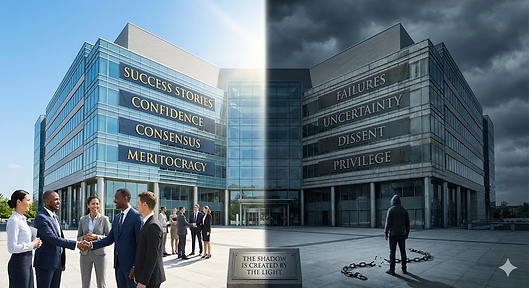
Every organization has a shadow.
It consists of the uncomfortable truths we do not discuss, the failures we do not acknowledge, the vulnerability we do not show, the dissent we do not welcome, and the privilege we do not examine. These elements are routinely pushed out of sight because they are psychologically and morally uncomfortable.
Yet suppression does not make these dynamics disappear. It simply forces them to operate in the dark, where they quietly constrain learning, erode trust, and limit adaptation in ways that organizations often fail to recognize.
My recent research applies Carl Jung’s concept of the shadow to organizational scholarship, arguing that both organizations and the scholars who study them systematically exclude inconvenient or marginalized experiences. This exclusion narrows what we are able to see, study, and improve.
The paradox is that what organizations suppress most aggressively often holds the key to their success. When the shadow is brought into view, when failure is normalized, vulnerability is legitimized, dissent is welcomed, and privilege is examined, organizations become more resilient, adaptive, and just.

The Framework: Integrating the Shadow
-
Article: (Tinsley, Kathawalla, & Cronin, 2024, Academy of Management Review)
The Problem
In Jungian psychology, the shadow refers to parts of the self that are rejected, denied, or left unintegrated because they conflict with social norms, moral expectations, or one’s self-image. These elements do not disappear. They remain active and continue to shape behavior from the background.
Organizations, and the scholars who study them, have shadows as well. Certain experiences and realities are systematically pushed out of view, not because they lack importance, but because they are difficult, uncomfortable, or disruptive to confront.
What Scholars Keep in the Shadow
Organizational scholarship frequently excludes phenomena that are difficult to measure, such as emotions, meaning, and lived experience; politically uncomfortable, such as power, privilege, and inequality; methodologically challenging, such as failure, deviance, and marginality; or theoretically inconvenient, such as contradictions, paradoxes, and exceptions.
By focusing primarily on what is visible, measurable, and socially acceptable, scholarship reproduces blind spots in both theory and practice. We develop interventions that overlook the unintended consequences of shadow dynamics, and we set aside promising ideas precisely because they make people uncomfortable.
What Organizations Keep in the Shadow
Organizations suppress failure by hiding mistakes, near-misses, abandoned projects, and failed strategies because these experiences threaten competence, invite blame, and signal weakness.
They suppress vulnerability by discouraging expressions of uncertainty, limits of knowledge, or requests for help because vulnerability appears to undermine authority and invite challenge.
They suppress dissent by marginalizing opposing views, uncomfortable questions, and minority perspectives because dissent is seen as threatening harmony, creating conflict, or signaling disloyalty.
They suppress privilege and inequality by avoiding conversations about unearned advantage, systemic bias, and structural unfairness because acknowledging these realities threatens legitimacy, raises questions of redistribution, and exposes injustice.

The Solution
Ironically, these suppressed elements are precisely what organizations need to function effectively. Learning requires acknowledging failure. Innovation depends on tolerating uncertainty. Adaptation demands openness to dissent. Equity is impossible without examining privilege.
Integrating the shadow begins with deliberate acknowledgment and examination.
Scholars can examine their shadow by asking which uncomfortable questions they avoid, which populations and experiences they systematically exclude, and which findings would destabilize their core assumptions.
Organizations can examine their shadow by creating safe spaces for vulnerability, studying near-misses and small failures rather than lauding success stories, and amplifying marginalized voices rather than defaulting to those already in power.
Integrating the shadow does not weaken organizations or scholarship. It expands what we are willing and able to see, and in doing so increases our capacity to learn, adapt, and improve.
Evidence: When Bringing the Shadow Into the Light Helps Organizations and Workers
1. Failure: From Stigma to Signal
Article: (Cronin, Erkens, Schloetzer, & Tinsley, 2021, The Accounting Review)
🏆 Winner: AICPA–CIMA Impact on Practice Award
Failure is typically treated as something to hide because it invites shame, blame, and denial. This research tested what happens when leaders encourage workers to embrace their failures.
In a field experiment at a Fortune 100 firm, half the workers were randomly assigned to watch videos where top leadership explicitly reframed failure as acceptable, inevitable, and informative. Employees were encouraged to share their own failures publicly and to celebrate what they learned from them.
Normalizing failure had measurable effects that strengthened over time rather than fading. Sales commissions for workers in the treatment condition were approximately 14 percent higher than the control group. This improvement was driven by a 16 percent increase in the odds of earning sales commissions in any given week, indicating workers sustained their effort rather than quitting after setbacks. Treating failure as a natural part of learning rather than an indictment of ability unlocked persistence that had previously been suppressed.
This work has also been translated for broader audiences, including Psychology Today in “In Celebration of the ‘F’ Word” and HuffPost in “Failure Is Not a Four-Letter Word.”
2. Vulnerability: Personal Stories Build Trust
Article: (Hagmann, Minson, & Tinsley, 2024, Journal of Applied Psychology)
Professional environments typically discourage vulnerability, emphasizing facts, analysis, and positions over lived experience. This study examined whether suppressing vulnerability prevents trust.
Participants with opposing political views on contentious issues were paired together. Some engaged in a standard debate, sharing positions and evidence. Others exposed personal narratives explaining why the issue mattered to them and how their views were shaped by experience.
The difference was striking. Standard debate increased polarization, reduced trust, and reinforced stereotypes about closed-mindedness. Exposing personal stories increased trust even when disagreement remained, humanized the other side, and promoted willingness to collaborate on a joint task.
Vulnerability worked because it signaled authentic engagement rather than strategic positioning, revealed the complexity behind people’s views, invited reciprocal openness, and corrected false assumptions about rigidity and bad faith.
3. Dissent: Psychological Capacity and Soft Skills vs Cash in Economic Development
Article: (Lang, Soule, & Tinsley, 2024, Economic Development and Cultural Change)
In economic development, material resources such as cash transfers and physical capital are treated as central, while psychological and social factors are relegated to the background as soft or secondary. This study challenged that assumption.
In a women’s empowerment initiative in Rwanda, researchers compared three interventions: cash transfers alone, psychological capital training focused on confidence and self-efficacy, and soft skills training focused on communication and collaboration.
Psychological capital alone produced income gains comparable to cash transfers. Soft skills training produced lasting effects that extended beyond the temporary impact of cash, which was quickly spent. These findings demonstrate that psychological and social capacities, often treated as peripheral, are critical constraints on economic participation.
This insight informed Kate Spade’s On Purpose initiative, which integrated psychological and social capacity training into workforce development.
4. Privilege: Why Organizations Struggle With Inequality
Articles: (Mayo & Tinsley, 2008, Journal of Economic Psychology; Kossek, Ladge, Little, Loyd, Smith, & Tinsley, 2024, Organizational Behavior and Human Decision Processes)
Early work explained why we are blind to our own privilege, discounting our luck to believe we earned all our rewards. This blind spot accounts for why wealthy don’t give more to charitable causes. Similarly, many organizations avoid open discussion of privilege and inequality because such conversations feel uncomfortable, politically charged, or divisive. Avoidance does not eliminate inequality. It pushes it into the shadows, where it becomes harder to diagnose, discuss, and address.
When inequality remains hidden, it is treated as a matter of personal sensitivity rather than an organizational challenge. The result is silence, misattribution, and stalled progress.
Advancing workplace equality requires more than symbolic commitments. Organizations must legitimize voice around inequality, recognize the often-invisible labor required to navigate unequal systems, and support allyship through structures rather than relying on individual courage alone.


Corporate Insights
Across failure, vulnerability, dissent, and privilege, the same pattern emerges. Keeping issues in the shadow feels safer in the short term. It protects self-image and organizational image, avoids discomfort and conflict, and requires no immediate change.
Bringing issues into the light creates discomfort in the short term. It challenges assumptions, threatens hierarchies, and forces difficult conversations. It requires adaptation. Yet only integration enables organizations to learn from mistakes, build trust across differences, hear early warnings, and address inequality before it becomes entrenched.
The shadow is not a liability to be eliminated. It is a resource to be integrated.
Invited Talks and Consulting: This work has been presented at The World Economic Forum in Davos and has informed practice in both private and Fortune 100 companies.

Key Publications
The Framework:
-
Tinsley, C.H., Kathawalla, R.R., & Cronin, M.A. (2024). Integrating the shadow within us to strengthen our field. Academy of Management Review, 49(3), 662-682.
Failure:
-
Cronin, M., Erkens, D.H., Schloetzer, J., & Tinsley, C.H. (2021). How controlling failure perceptions affects performance: Evidence from a field experiment. The Accounting Review, 96(2), 205-230.
-
🏆 AICPA-CIMA Impact on Practice Award
-
Vulnerability:
-
Hagmann, D., Minson, J.A., & Tinsley, C.H. (2024). Personal narratives build trust across ideological divides. Journal of Applied Psychology, 109(11), 1693-1715.
Dissent & Economic Development:
-
Lang, M.E., Soule, E., & Tinsley, C.H. (2024). Psychology, soft skills, or cash? Evidence on marginal investments. Economic Development and Cultural Change, 73(1).
Privilege & Inequality:
-
Mayo, J.W. & Tinsley, C.H. (2008). Warm glow and charitable giving: Why do not the wealthy give more to charity? Journal of Economic Psychology
-
Kossek, E.E., Ladge, J., Little, L.M., Loyd, D.L., Smith, A.N., & Tinsley, C.H. (2024). Introduction to the special issue: Allyship, advocacy, and social justice to support equality for marginalized groups in the workplace. Organizational Behavior and Human Decision Processes, 183
Emerging Questions:
-
What determines which organizations can integrate shadow vs. which reject it?
-
How does remote work change what's visible vs. hidden?
-
Can shadow integration be measured as organizational capability?