

Gender & Bias: The Hidden Architecture of Inequality
A woman speaks up forcefully in a meeting and is described as abrasive.
A man does the same thing and is called decisive.
A woman negotiates hard and is warned she’s “hurting relationships.”
A man negotiates hard and is praised for “knowing his worth.”
Most people don’t see these moments as discrimination. They see them as personality differences, leadership styles, or individual choices.
That’s exactly the problem.
Why Inequality Persists—Even When No One Thinks They’re Biased
Despite decades of diversity initiatives, women’s educational gains, and widespread organizational commitment to equity, gender inequality stubbornly persists. Why?
Because the most powerful forms of inequality don’t announce themselves.
They work quietly, through everyday assumptions that feel reasonable, neutral—even fair.
My research shows that gender inequality endures not primarily because of overt discrimination or hostile intent, but because invisible beliefs align seamlessly with institutional systems. Together, they make unequal outcomes look natural, rational, and self-chosen.
What we label “common sense,” “merit,” or “personal preference” often isn’t neutral at all. It systematically disadvantages women—while remaining largely invisible to everyone involved.
This research spans more than two decades and appears in leading academic journals as well as practitioner outlets. I’ve shared these ideas with business leaders, policymakers, lawyers, and organizations across industries. The findings are often uncomfortable—but they are also actionable.
Once we see the hidden architecture, we can rebuild it.

The Problem: Inequality That Feels Natural
Ask people why gender inequality exists, and you’ll usually hear some version of the same explanations:
-
A few biased individuals or “bad actors”
-
Women’s different preferences or choices
-
Pipeline problems—too few qualified women
-
Work–family conflicts
These explanations aren’t entirely wrong. But they’re incomplete.
They describe where inequality shows up, not how it’s produced.
The real engine of inequality operates at a deeper level—where beliefs and systems quietly reinforce each other.
The Hidden Architecture of Inequality:
Gender inequality is built from two interlocking components.
1. Gendered Beliefs & Expectations (The Mental Model)
Unspoken beliefs about what is “appropriate,” “natural,” or “effective” for men versus women shape how identical behavior is interpreted. As a result, women are far more likely to face a likability–competence tradeoff.
2. Structural Constraints & Choice Architecture (The Institutional Framework)
Organizational systems—policies, norms, evaluation criteria—often appear neutral. But they are typically designed around a narrow model of the “ideal worker”: someone with uninterrupted career paths, constant availability, and minimal caregiving responsibilities.
Together, these components create a self-reinforcing system where inequality feels like the natural result of individual differences rather than a socially constructed outcome.
Evidence from Every Rung on the Corporate Ladder
1. Gendered Beliefs & Expectations (The Mental Model)
(Tinsley, Cheldelin, Schneider, & Amanatullah, 2009, Negotiation Journal; Schneider, Tinsley, Cheldelin, & Amanatullah, 2010, Duke Journal of Gender Law & Policy; Amanatullah & Tinsley, 2013, Organizational Behavior and Human Decision Processes; Amanatullah & Tinsley, 2013; Negotiation and Conflict Management Research)
Whether entry level workers or top leaders, invisible norms create a likability-competence dilemma for women. When women behave assertively, they are often seen as competent but unlikable. When they behave cooperatively, they are seen as likable but less competent.
It’s an impossible bind:
-
Act assertively and risk social and material penalties
-
Act communally and risk being seen as weak or unqualified
Men don’t face this tradeoff. They can be both competent and likable at the same time.
Women leaders, particularly visible ones like political figures, face a double bind: behaviors associated with leadership competence (directness, confidence, self-promotion) often reduce likability, while behaviors associated with warmth and collaboration reduce perceived competence.
This word cloud based on analysis of the 2008 election coverage shows systematic differences in male and female candidate characterizations.
Importantly, much of this discrimination is subconscious. Evaluators genuinely believe they are judging individuals and their merit—while unknowingly applying different standards based on gender.
2. Structural Constraints & Choice Architecture (The Institutional Framework)
(Tinsley, Howell, & Amanatullah, 2015, Organizational Behavior and Human Decision Processes; Kugler, Tinsley, & Ukhaneva, 2021, Economics of Education Review; Hagmann, Sajons, & Tinsley, 2025, Management Science)
(The Institutional Framework)
Organizational systems are typically designed around a narrow model of the “ideal worker”: someone with uninterrupted career paths, constant availability, and minimal caregiving responsibilities. These systems quietly advantage those who fit traditional male career patterns.
As a result, outcomes shaped by structure are routinely misattributed to individual choice.
For example, when we asked a nationwide sample, “In a two-career household, who should be the higher earner?” both men and women expressed a strong preference for men earning more—often justified as natural or biological. These beliefs then shape real decisions: whose job takes priority, who scales back, and who absorbs more unpaid labor at home.
Similarly, women’s underrepresentation in high-paying STEM fields is often explained as preference—girls just don’t like math or science. But closer examination reveals a different story: unequal preparation, different feedback and encouragement, unequal access to role models, and persistent signals about who “belongs.”
Even highly educated, statistically sophisticated decision-makers are not immune. In hiring and promotion, people often misinterpret gender imbalances as evidence of underperformance—failing to adjust for base rates. When men vastly outnumber women in a field, women’s lower representation among “top performers” is taken as proof of lower ability, even when performance is equal.
The bias hides inside what looks like objective reasoning.
The Bottom Line
What appear to be natural differences in ambition, preference, or performance often reflect invisible gender rules embedded in beliefs and systems.
Inequality persists not because people endorse it—but because they don’t see it.


The Solution: Make the Invisible Visible—and Redesign the System
If inequality is built into systems, then systems—not women—need to change.
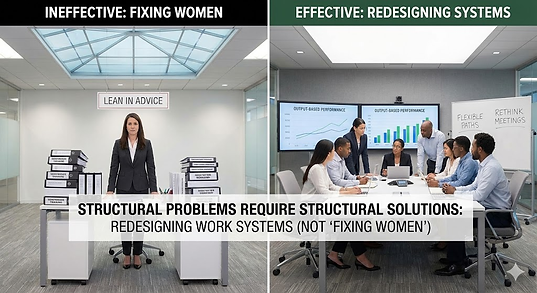
1. Redesigning Work Systems (Not “Fixing Women”) (Tinsley & Ely, 2018, Harvard Business Review)
Many well-intentioned diversity initiatives fail because they misdiagnose the problem.
Common—but ineffective—approaches include:
-
Confidence training and negotiation workshops
-
“Lean in” advice
-
Recruitment pipelines and numerical targets
These efforts assume the issue lies in women’s skills, confidence, or numbers. As a result:
-
Trained women still face biased evaluation
-
New hires enter the same inequitable systems
-
Representation improves, but advancement and retention stall
-
Diversity becomes visible, but inclusion does not
What works instead is redesigning the workplace itself:
-
Supporting multiple life paths—not just the “ideal worker”
-
Evaluating performance based on output, not presence
-
Rethinking meeting norms, client demands, and promotion criteria
-
Actively questioning assumptions about competence, commitment, and leadership
Structural problems require structural solutions.
2. The Legitimacy Solution: Why Board Experience Matters (Tinsley & Purmal, 2019, Harvard Business Review)
One structural intervention with powerful effects is board service for women executives.
Women with board experience are significantly more likely to reach the CEO role—especially in male-dominated industries. Why?
Because board service acts as a widely recognized legitimacy signal. It:
-
Signals readiness for the C-suite
-
Provides access to elite networks
-
Creates peer relationships with sitting CEOs
-
Reduces perceived risk in promoting women
The irony is telling: women often need additional credentials to be seen as equally qualified for roles men attain without them.

What’s Hidden Governs Outcomes
Across this body of research, one theme is constant:
what we treat as personal choice is often socially constructed and structurally constrained.
That insight is both sobering and empowering.
Sobering, because individual-level fixes—confidence training, negotiation workshops, self-help advice—cannot solve systemic problems. They may even backfire by implying women are the problem.
Empowering, because systems are designed by people. And what has been designed can be redesigned.
Once we see the hidden architecture, we gain the power to change it.
Key Publications
Backlash & Expectations:
-
Amanatullah, E.T. & Tinsley, C.H. (2013). Negotiating for me, you and us: Advocacy as a moderator of backlash against female negotiators. Organizational Behavior and Human Decision Processes, 102(1), 110-122.
-
Amanatullah, E.T. & Tinsley, C.H. (2013). Ask and ye shall receive? How gender and status moderate negotiation success. Negotiation and Conflict Management Research, 6(4), 253-272.
-
Tinsley, C.H., Cheldelin, S.I., Schneider, A.K., & Amanatullah, E.T. (2009). Women at the bargaining table: Pitfalls and prospects. Negotiation Journal, 25(2), 233-248.
-
Schneider, A.K., Tinsley, C.H., Cheldelin, S., & Amanatullah, E.T. (2010). Likability v. competence: The impossible choice faced by female politicians, attenuated by lawyers. Duke Journal of Gender Law & Policy, 17(2), 363-384.
Structural Constraints:
-
Hagmann, D., Sajons, G., & Tinsley, C.H. (2025). Base rate neglect as a source of inaccurate statistical discrimination. Management Science. https://doi.org/10.1287/mnsc.2023.00603
-
Kugler, A.D., Tinsley, C.H., & Ukhaneva, O. (2021). Gender and choice of majors: Are women really different from men? Economics of Education Review, 81, 1-19.
-
Tinsley, C.H., Howell, T.M., & Amanatullah, E.T. (2015). Who should bring home the bacon? How gender deterministic views constrain spousal wage preferences. Organizational Behavior and Human Decision Processes, 126, 37-48.
-
Tinsley, C.H., Wade, J., Main, B.G.M., & O'Reilly, C.A. (2017). Gender diversity on U.S. corporate boards: Are we running in place? Industrial Labor Relations Review, 70(1), 160-189.
Practitioner Writing:
- Tinsley, C.H. & Ely, R.J. (2018). What most companies get wrong about men and women. Harvard Business Review, May/June.
-
Tinsley, C.H. & Purmal, K. (2019). Board experience is helping more women get CEO jobs. Harvard Business Review, July.
-
Babcock, L., Tinsley, C.H., Bowles, H., & Kray, L. (2014). Why leaning in can backfire. Boston Globe, April.
-
Tinsley, C.H. (2008). Still not ready: For female candidates, latent biases matter. Washington Post, June 1.
HuffPost Series on Hidden Gender Dynamics:
- Show Us the Money - Pay transparency
-
On the Money! - Women and financial discomfort
-
Stop Perpetuating Gender Stereotypes with Children's Christmas Toys
-
Women & Girls in Sports: When Will We Accept the New Normal?
Current & Future Directions
Active Research:
-
How positive stereotypes about female leadership can backfire
-
Virtual reality studies of negotiation and gender
-
Impact of failing to promote women on perceptions of diversity efforts
Emerging Questions:
-
How does remote work change gendered evaluation patterns?
-
Can AI reduce or amplify statistical discrimination?
-
What makes some organizations better at structural change than others?